March 13, 2026
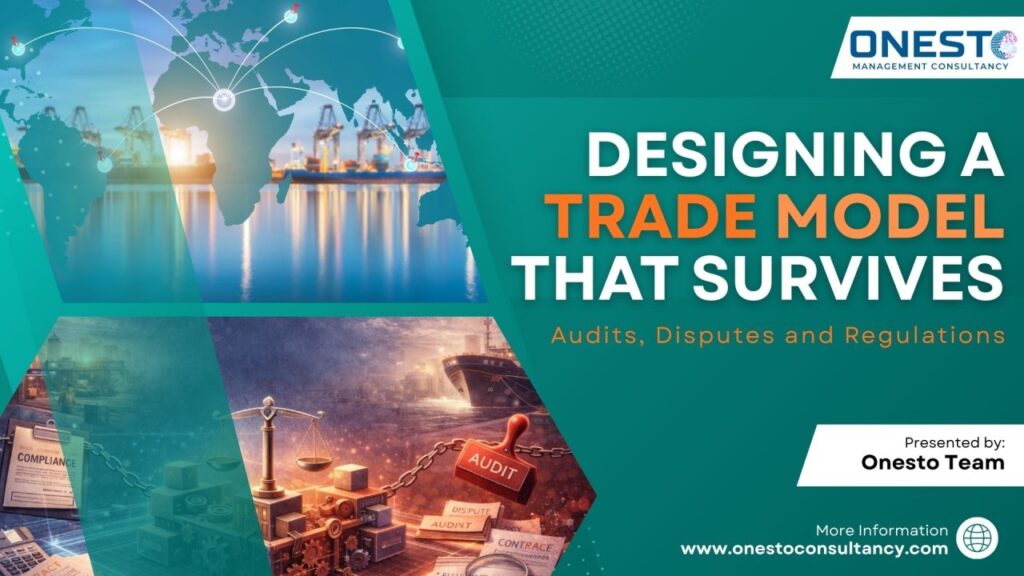
Many international trade structures look successful—until they are tested. The real test does not come with the first shipment or the first invoice. It comes when:
By 2026, these situations are no longer exceptions. They are part of normal cross-border operations—especially in EU-linked trade corridors. The question is no longer whether a trade model will be tested. It is whether it was designed to survive the test.
Several structural shifts are reshaping international trade:
In this environment, informal or transaction-only trade setups are increasingly fragile. What worked in 2018–2020 is now a liability.
A resilient trade model is not one that avoids problems. It is one that absorbs them without breaking. Such a model is designed across four interlinked layers:
Most failures occur because one or more of these layers is missing—or outsourced blindly.
Many exporters rely on generic contracts drafted for speed. These often fail to address: Jurisdiction and governing law clarity, Dispute resolution mechanisms (arbitration vs litigation), Change-in-law scenarios, and Regulatory liability allocation.
In EU-linked trade, courts and regulators increasingly examine who contractually owns compliance risk. A resilient model:
Legal structure is no longer a formality—it is the backbone.
Traditional trade negotiations focus on: Unit price, Delivery terms, and Payment timelines. What is often ignored:
By 2026, buyers—especially in the EU—expect suppliers to carry a defined share of regulatory risk. Trade models that do not price or allocate this risk transparently tend to collapse under pressure.
One of the clearest patterns in failed expansions is this: Compliance was outsourced, fragmented, or reactive. Relying entirely on: Freight forwarders, Agents, and Buyers creates blind spots. Regulators and auditors increasingly expect exporters to demonstrate:
A resilient model treats compliance as:
Not as paperwork to be “handled when needed”.
Growth exposes weaknesses. As volumes increase, companies face: More documentation touch points, More stakeholders, and More regulatory interfaces. Without governance, this leads to:
Strong trade models include:
This is where many first-time exporters struggle the most.
In EU-linked trade, audits are becoming normalised. They are triggered not only by suspicion, but by: Volume thresholds, Product categories, and Regulatory updates. A resilient trade model:
Companies that panic during audits are usually those encountering them for the first time.
Trade disputes rarely originate from product failure. They arise from:
When disputes escalate, companies often realise:
Designing for dispute does not mean expecting conflict—it means preventing escalation.
Spain increasingly serves as:
Companies that anchor their EU strategy through Spain often:
This makes Spain strategically valuable beyond bilateral trade numbers.
In today’s environment, trade models cannot be built by:
They must be designed intentionally, with foresight. The companies that will succeed through 2026 and beyond are those that:
We work with companies to design trade models that remain functional when tested by audits, disputes, and regulation—not just when conditions are ideal.
Trade that survives scrutiny is trade that lasts.
Tell us what you are trying to do in India or Europe. A partner replies within one working day.